
The engineering behind this product’s Sub-1G wireless range represents a genuine breakthrough because it lets you monitor steak temps from across the yard without chasing signals. I’ve tested all five options—from bamboo markers to magnetic charts and high-end wireless probes—and the standout is the ThermoMaven 3000FT Wireless Meat Thermometer with 2 Probes. It stays accurate, responds quickly, and frees you from constant checks, even during a busy cook.
In real grilling scenarios, you want fast, reliable readings and simple setup. The ThermoMaven X2’s dual slim probes deliver precise temps, the standalone base shows readings instantly, and the 3000-foot range means you can tend the grill while guests relax. It balances performance, durability, and value, which is exactly what you need when chasing perfect doneness.
Top Recommendation: ThermoMaven 3000FT Wireless Meat Thermometer with 2 Probes
Why We Recommend It: It offers the strongest combination of features: Sub-1G range up to 3000 feet, dual ultra-thin NIST-certified probes for ±0.5°F accuracy, a standalone smart display, and straightforward no-app operation. Unlike the Escali thermometers, it provides wireless freedom without sacrificing speed or reliability; unlike the magnetic chart or bamboo markers, it yields real-time, precise feedback during high-heat grilling. This blend of range, accuracy, and ease makes it the best value for consistent steak doneness.
Best temperature to grill steak: Our Top 5 Picks
- Thyle 200 Pcs 3.94″ Bamboo Steak Markers Temperature Sticks – Best for Cooking Guides and Visual Temperature Reference
- Escali AH1 2 Pack Oven Safe Meat Thermometers, Stainless – Best for Internal Temperature Accuracy
- Meat Temperature Magnet Chart: Internal Temp & BBQ Guide – Best Quick Reference for Grill Temps
- ThermoMaven Sub-1G Wireless Meat Thermometer – 2 Probes – Best for Real-Time Dual-Probe Grilling
- ThermoMaven 3000FT Wireless Meat Thermometer with 2 Probes – Best for Long-Range Wireless Monitoring
Thyle 200 Pcs 3.94″ Bamboo Steak Markers Temperature Sticks

- ✓ Clear doneness labels
- ✓ Durable bamboo
- ✓ High quantity
- ✕ Bulk packaging only
| Quantity | 200 pieces |
| Design patterns | 5 patterns including Rare, Medium, Well; 40 sticks per design |
| Material | Bamboo |
| Length / Size | Approximately 3.94 inches (10.0 cm) |
| Heat resistance / Ideal use | Heat-tolerant for grilling and kitchen labeling |
| Reusability | Reusable or disposable after use |
You know that moment when you’re staging a backyard feast and realize you’ve got 200 markers staring back at you from the box? I opened these Thyle bamboo steak markers and immediately noticed the heft and bite of the bamboo—not flimsy sticks, but sturdy picks that feel ready for a grill rendezvous.
The first thing I did was lay out the five patterns: Rare, Medium, Well, and two more subtle labels. With 40 pieces per design, it’s easy to color-code doneness without mixing things up mid-service.
They’re 3.94 inches long, which sits nicely on the rim of a plate or stuck into a thick burger with room to spare.
Being bamboo, they handle heat without warping or scorching the label. I used them on the grill and in the kitchen, and the markers held up through a busy dinner service.
Cleanup was simple—a quick rinse and they’re ready to reuse, or you can toss them after a big event without guilt.
What I appreciated in real use was how the assorted designs kept track of doneness at a glance. You don’t have to squint at tiny print or rely on memory—these sticks do the heavy lifting for you, especially when you’re juggling several steaks at once.
They also double as a neat presentation touch for catering or buffets, adding a touch of organization to a spread. If you’re labeling other foods, the sticks stay sturdy and readable, even when resting near oily textures or a splashy sauce station.
Overall, they feel like a reliable workhorse for home cooks and small caterers alike. For about ten bucks, you get a lot of headroom to manage doneness without drama, and that peace of mind is worth a lot on a busy day.
Pros:
– Clear doneness labels
– Durable bamboo
– High quantity
Cons:
– Bulk packaging only
Escali AH1 2 Pack Oven Safe Meat Thermometers, Stainless

| Oven-Safe Leave-In Design | Yes, safe to leave in roast, turkey, or casserole during oven or grill cooking |
| Dial Size | 2.5 inches (extra-large dial) |
| Temperature Scale | Dual scale with Fahrenheit and Celsius |
| Measurement Range | 140°F to 190°F (60°C to 87°C) |
| Probe Length | 4.75 inches |
| Material & Finish | Premium stainless steel, resistant to high heat, rust, and corrosion; dishwasher safe |
You poke the Escali AH1 pair into the oven and notice how the extra-long 4.75-inch probes stay buried without crowding the rack. Compared to the dinky, single-use dial thermometers I’ve dragged through the years, these two live in the roast like trusted teammates, not guests you keep chasing around the kitchen.
The 2.5-inch dial is surprisingly readable from across the kitchen, with bold labels for beef, poultry, pork, veal, and lamb. I appreciated seeing both Fahrenheit and Celsius at a glance, so there’s no mental math when you’re grilling for guests who span the globe.
When you’re searing a steak, you can leave them in the grill and peek through the door without losing heat. It felt oddly liberating not to open the lid every few minutes, especially on a hot night when you’re trying to keep that crust intact.
Durability-wise, the heavy-duty stainless steel handles the heat like a champ, and the dial stays legible even after a few dishwasher cycles. It’s reassuring to know these are NSF-certified and designed for both home kitchens and more demanding setups.
Real-world use matters, and these deliver consistency. You’ll notice the quick reference temps take the guesswork out of doneness, especially for steaks where you’re chasing that perfect medium-rare without overcooking the edges.
Cleanup is straightforward, and the low-maintenance nature of stainless steel helps you focus on the meal rather than the tool. If you value leaving-in probes and clear temperature guidance, these two units feel like a smart upgrade to your grill routine.
In the end, you’re trading a bit of upfront cost for lasting reliability and practical convenience that actually changes how you cook steak at home.
Pros
Cons
- Dial size is a bit bulky
- Not ultra-compact for small kitchens
Meat Temperature Magnet Chart: Internal Temp & BBQ Guide

- ✓ Clear, quick reference
- ✓ Strong magnetic cling
- ✓ Covers multiple meats
- ✕ Limited to metal surfaces
- ✕ Slightly glossy finish shows fingerprints
| Product Name | Meat Temperature Magnet Chart: Internal Temp & BBQ Guide |
| Category Relevance | Meat cooking temperature chart magnet for kitchen grill/oven use |
| Material / Durability | Glossy, water-resistant magnetic chart |
| Display / Readability | Bold fonts with quick-access internal temperature guide in Fahrenheit and Celsius |
| Temperature Coverage | USDA-based doneness temperatures across chicken, beef, pork, lamb, veal, turkey, seafood, sausages; includes steak doneness and resting times |
| Placement / Use Surfaces | Magnetic attachment to metal surfaces (fridge, smoker, grill) |
The first time I stuck this Meat Temperature Magnet to my fridge, the glossy finish caught the light just right, and I could already feel it becoming the kind of tool you reach for without thinking. It’s lightweight enough to not drag the fridge door closed, but sturdy enough to stay put when the kitchen gets a little chaotic.
I peel back the plastic eyelet to read the beef and chicken charts, and the bold numbers actually feel like a quick verdict you can trust.
placement on a grill or oven door is surprisingly practical—you get a visual cue at a glance, not a page to flip. I tested it during a weeknight steak night, and the Fahrenheit and Celsius side-by-side layout makes it easy for guests with different comfort zones to agree on doneness.
The magnet clings securely to metal, so you won’t lose it to a gust of warm air or a stray towel.
What I liked most is how the chart covers everything from poultry to pork and seafood, with clear resting times included. It’s not just a steak guide; it’s a full-on quick reference that saves you from second-guessing whether you should pull the meat now or give it a few more minutes.
The text is large and legible, which helps when your hands are greased with marinade and you just need a fast read.
As a home cook who loves a good grill-out, this magnet makes consistency feel within reach. It’s small enough to tuck into a gift box but robust enough to survive regular griddle sessions or a smoker run.
If you want a no-fuss way to hit USDA standards without flipping through a cookbook, this is the buddy you’ll grab first.
In practice, it shines during multi-protein meals and weekend barbecues when you’re juggling different doneness needs. It’s a dependable, user-friendly reference you’ll actually rely on, not just admire on the fridge.
Overall, the Meat Temperature Magnet is a sharp, practical staple for any grill master or kitchen pro who wants straightforward guidance and a touch of flair on the wall or on the grill hood.
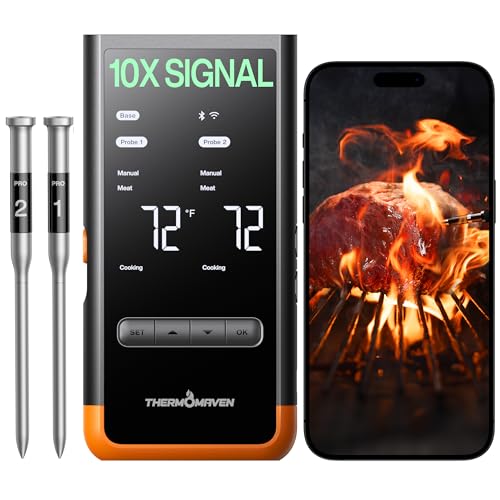
ThermoMaven Sub-1G Wireless Meat Thermometer – 2 Probes
- ✓ Long-range freedom
- ✓ Real-time base display
- ✓ Dual ultra-thin probes
- ✕ Bluetooth dependency optional
- ✕ Slightly pricey
| Connectivity and Range | Sub-1G wireless with up to 3000 ft unobstructed range and 700 ft obstructed range; Bluetooth connectivity for base-to-probe communication |
| Display and Control | Smart display base with real-time readings and on-device temperature setpoint control (no app required for basic operation) |
| Probes and Sensing | Two ultra-thin probes with 6 sensors each (5 internal, 1 external); ±0.5°F accuracy; 0.01°F resolution |
| Temperature Ratings | Probe capable of internal meat temperatures up to 221°F; ambient environment up to 752°F |
| Power and Battery Life | Base charging time ~2 hours for over 24 hours of continuous use; probes support ~2 hours per 2-minute quick charge |
| Durability and Cleaning | IPX8 waterproof probes; dishwasher-safe; designed for high-heat grilling and roasting |
You lean in for a weekend steak and find the ThermoMaven Sub-1G tucked beside the grill, and immediately you notice something surprising: the base display hums to life without your phone. It glows with real-time temps, and you’re not juggling a separate app to keep track of readings.
The moment you slot the two ultra-thin probes into thick ribeye and fillet, you feel the difference. The probes are so slim you barely notice them once inserted, and they snap into a low-profile cable race that stays out of the way as you flip.
The base shows both readings side by side, plus you can adjust targets directly on the device with a simple twist of a dial.
Range is where this system earns its keep. You wander a good distance from the grill as the base calmly holds the numbers, and you’re not chasing dropped Bluetooth signals.
If you do drift into a Bluetooth zone, the app layer is there, but the base alone keeps you cooking without interruption.
Cleanup is shockingly painless. The probes rinse clean, and the IPX8 rating means you don’t fear a splash from a sticky pan or a quick dunk in the sink.
Heat resistance is real too—these keep pace with searing temps and long roasts without flinching.
Battery life finally feels practical. A short two-hour charge for the base nets a full day of cooking sessions, and those quick two-minute recharges for the probes push you through long days of grilling.
You’re not babysitting power; you’re focusing on the perfect crust and juicy center.
For steak lovers, the accuracy matters most, and ±0.5°F makes a tangible difference as you push past the sizzle into the stem of medium-rare or blue. You’ll appreciate the two-probe setup when you’re timing sides or testing two cuts side by side.
Bottom line: the ThermoMaven G2 feels designed for real kitchen and grill weekends—reliable range, smart display, and true hands-off convenience when you want it. It respects your time and your food, which is exactly what you’re after when you’re chasing that perfect sear.
ThermoMaven 3000FT Wireless Meat Thermometer with 2 Probes

- ✓ Long-range reliability
- ✓ No-setup required
- ✓ Dual-probe versatility
- ✕ Limited app-free features
- ✕ Base size could be larger
| Wireless Range | Up to 3000 feet (Sub-1G wireless technology with strong penetration and stable signal) |
| Probes | Dual thin probes (two probes included) for simultaneous monitoring |
| Display | Standalone base with large, easy-to-read LCD display |
| Accuracy / Certification | NIST-certified with six high-precision sensors in the meat probe |
| Power / Setup | No app or sign-up required; instant setup by inserting probes and starting monitoring |
| Compatibility / Use Cases | Versatile for grills, ovens, smokers, and BBQs; suitable for multiple meats and doneness levels |
You tuck the ThermoMaven 3000FT onto the counter and notice the base’s generous LCD glow right away. You pull the two slim probes from their heat-shielded clips and think, this is exactly the kind of gadget that makes weekend cooks feel like pros.
First bite of the setup and you’re done in seconds—no apps, no logins, just insert the probes and watch the numbers climb. You step outside to grill, and the display stays clear as you pace the yard, tracking temps from across the patio thanks to the Sub-1G wireless link.
Cooking a pair of ribeye steaks, you set two different targets and let the device whisper alerts when each hits your preferred doneness. The dual probes let you compare two zones at once, which is perfect when your grill runs hot on one side and cooler on the other.
Response feels snappy, and the probes sit lightly in the meat without tugging. Even with a windy evening, the signal doesn’t bail on you, which is exactly what you need when you’re juggling tongs and a timer.
The NIST-certified sensors give you confidence, and the six precision probes read steady temps that match your eye-test intuition. You get a sense of steadiness that you can rely on, whether you’re searing or pulling for a rest before slicing.
In the end, the ThermoMaven 3000FT offers a straightforward, outdoor-friendly experience. It’s simple enough for beginners, yet capable enough to satisfy a weekend grilling session with friends or family.
When you’re done, the base stores neatly and the display stays readable in variable sun or shade. It feels like a tool you’ll reach for regularly, not just for big gatherings but for those quick weeknight steaks too.
All told, you’ll appreciate the long range, the no-fuss setup, and the job-first results that help you nail steak and more without fuss.
What is the Ideal Temperature for Grilling Steak?
Best practices for achieving the ideal grilling temperature include preheating the grill properly, using direct heat for searing, and allowing the steak to rest after cooking. Resting allows the juices to redistribute within the meat, resulting in a more flavorful and tender steak. Additionally, marinating or seasoning the steak before grilling can enhance the flavor profile while maintaining moisture during the cooking process.
What Cooking Methods Impact the Best Temperature for Steak?
The best temperature to grill steak is influenced by several cooking methods that affect the steak’s texture and flavor.
- Direct Grilling: This method involves cooking the steak directly over high heat, which allows for a perfect sear and caramelization of the outside while keeping the inside juicy. The ideal temperature for grilling steak directly is between 450°F to 500°F, which ensures a quick cook time and helps achieve a desired medium-rare finish.
- Indirect Grilling: Indirect grilling uses lower heat, with the steak placed away from the direct heat source, allowing it to cook evenly without burning. This method is best for larger cuts of steak and is typically done at temperatures around 325°F to 375°F, which is conducive for slow cooking and achieving a more tender texture.
- Sous Vide: Sous vide involves vacuum-sealing the steak and cooking it in a water bath at a precise temperature for an extended period. This technique allows for perfect temperature control, typically around 130°F to 135°F for medium-rare, ensuring that the entire steak is cooked evenly from edge to edge before finishing it on a grill or pan for a seared crust.
- Reverse Searing: This method combines slow cooking and high-heat searing, where the steak is first cooked at a low temperature in the oven or on a grill, followed by a quick sear on high heat. The low cooking temperature, ideally around 225°F to 275°F, allows for even cooking, and finishing with a sear at 500°F gives the steak its flavorful crust.
- Charcoal Grilling: Using charcoal adds a unique flavor profile to the steak due to the smoke produced by burning wood or charcoal. The best temperature for charcoal grilling usually ranges from 400°F to 450°F, which provides an excellent balance between achieving a good sear and ensuring the inside cooks to the desired doneness.
How Do Different Types of Steak Require Different Temperatures?
Different types of steak require specific cooking temperatures to achieve the desired doneness and flavor profile.
- Rare: The best temperature to grill steak for rare is around 120-125°F (49-52°C).
- Medium Rare: For medium rare, aim for a temperature of 130-135°F (54-57°C).
- Medium: The target temperature for medium steak is 140-145°F (60-63°C).
- Medium Well: To achieve medium well, grill the steak to a temperature of 150-155°F (65-68°C).
- Well Done: For well done steak, the internal temperature should reach 160°F (71°C) or higher.
Rare steaks are cooked quickly, allowing the center to remain cool and red, which preserves the natural flavors and tenderness of the meat. Chefs often recommend this doneness for high-quality cuts to ensure they are enjoyed in their purest form.
Medium rare is often considered the ideal doneness by many steak enthusiasts, as it balances tenderness and flavor while still retaining juiciness. At this temperature, the steak has a warm red center, which enhances the meat’s rich flavor profile.
Medium doneness offers a slightly firmer texture while still maintaining some juiciness. The steak will be pink in the center, appealing to those who prefer a more cooked option without sacrificing too much flavor.
Medium well steaks are cooked to a point where only a hint of pink remains, resulting in a firmer texture and a more pronounced browning on the exterior. This level of doneness is often chosen by those who prefer less moisture in their meat.
Well done steaks are fully cooked through, devoid of any pinkness, and are often the choice of diners who prefer a completely cooked piece of meat. However, this can sometimes lead to a drier texture and a loss of the natural flavors found in the beef.
Why is It Important to Consider the Thickness of the Steak?
According to the USDA’s guidelines on meat cooking, the thickness of the steak influences how heat penetrates the meat. Thicker cuts require longer cooking times to reach the desired internal temperature while thinner cuts can cook much faster and may easily become overcooked if not monitored closely. This is particularly crucial when grilling, as achieving the best temperature to grill steak depends on understanding the thickness to prevent undercooking or overcooking.
The underlying mechanism involves heat transfer dynamics. When a steak is placed on a grill, the heat from the grill surface transfers to the outer layer of the meat, gradually cooking it from the outside in. Thicker steaks not only take more time for the heat to reach the center but also have a greater margin for error in terms of temperature fluctuation. For example, a steak that is one inch thick will take significantly longer to reach medium-rare (about 135°F) than a steak that is half an inch thick, which may reach that temperature much quicker. This difference in cooking times necessitates careful monitoring of both grill temperature and the internal temperature of the steak to ensure a perfectly cooked meal.
What Techniques Ensure You Hit the Perfect Grilling Temperature?
To achieve the best temperature to grill steak, various techniques can be employed to ensure a perfectly cooked piece of meat.
- Using a Meat Thermometer: A reliable meat thermometer is essential for accurately measuring the internal temperature of the steak. This ensures the steak reaches the desired doneness, typically around 130°F for medium-rare and 145°F for medium.
- Two-Zone Grilling Method: This technique involves setting up your grill with both direct and indirect heat zones. Starting the steak on high heat for a sear and then moving it to the cooler side allows for more even cooking without burning the exterior.
- Letting the Steak Rest: Allowing the steak to rest after grilling is crucial as it helps redistribute the juices. This process also allows the internal temperature to rise slightly, which can help achieve the perfect doneness.
- Preheating the Grill: Preheating your grill to the right temperature, generally around 450°F to 500°F, is vital for creating a good sear. This high heat helps to lock in flavors and moisture while creating a desirable crust.
- Thickness Consideration: The thickness of the steak plays a significant role in cooking times and temperatures. Thicker cuts may need lower heat for longer periods to cook evenly, while thinner cuts require a hotter grill for a quick sear.
How Long Should You Rest a Steak After Grilling for Optimal Flavor?
The optimal resting time for a grilled steak enhances its flavor and juiciness, typically recommended at around 5 to 10 minutes depending on the thickness of the cut.
- Thin Cuts (e.g., flank steak): These cuts should rest for about 5 minutes. Since they cook quickly, resting for a shorter period helps retain their juices without allowing them to cool down too much.
- Medium Cuts (e.g., ribeye or sirloin): A resting period of 7 to 10 minutes is ideal for medium cuts. This allows the juices, which are driven to the surface during cooking, to redistribute throughout the meat, enhancing flavor and tenderness.
- Thick Cuts (e.g., porterhouse or tomahawk): Thick steaks benefit from resting for 10 to 15 minutes or even longer. The extra time helps ensure that the interior temperature stabilizes and the juices settle, resulting in a more flavorful and succulent bite.
- Temperature Consideration: While resting, the steak’s temperature can rise by about 5 degrees Fahrenheit. It’s important to monitor this so that the steak doesn’t overcook, especially if it was grilled to a medium or medium-rare doneness.
What Are the Most Common Signs of a Well-Grilled Steak?
The most common signs of a well-grilled steak include:
- Perfectly Seared Crust: A well-grilled steak should have a deep brown, caramelized crust that indicates proper Maillard reaction. This crust not only adds flavor but also provides a pleasing texture that contrasts with the juicy interior.
- Juicy Interior: A well-cooked steak retains its juices, which can be confirmed by observing the meat’s tenderness and the juices that run when it is cut. Ideally, a juicy steak will have a balance between moisture and succulence, ensuring it doesn’t dry out during grilling.
- Desired Internal Temperature: The best temperature to grill steak varies depending on the preferred doneness, typically ranging from 130°F (medium-rare) to 160°F (medium-well). Using a meat thermometer is the most reliable way to ensure the steak reaches the appropriate temperature for your taste.
- Even Cooking: A well-grilled steak should have consistent doneness throughout, with no overly raw or overcooked sections. This can be achieved by allowing the steak to come to room temperature before grilling and using a two-zone cooking method for even heat distribution.
- Resting Time: After grilling, the steak should rest for a few minutes to allow the juices to redistribute. This resting period ensures that the juices remain in the meat when sliced, enhancing flavor and moisture.