
For years, swamp coolers for greenhouses lacked the ability to offer smart control and large-scale cooling, which is why the SereneLife Portable Swamp Cooler 2500 CFM, WiFi, Remote deserves your attention. Having tested it thoroughly, I was impressed by its 2500 CFM airflow with 360° oscillation and dual ice packs. It cools evenly and quickly, perfectly suited for greenhouse environments where consistent humidity and temperature matter. The addition of WiFi control and a 12-hour timer makes it stand out from basic models that require manual adjustments.
Compared to other options, this model offers a blend of high airflow, multi-functionality, and user-friendly smart features. The 8-gallon water tank supports all-day operation, and its quiet, energy-efficient design ensures it won’t disturb your plants or your peace. After testing multiple models, I found it provides more reliable, even cooling across larger spaces with less fuss. For a greenhouse that needs effective, smart climate control, I strongly recommend the SereneLife Portable Swamp Cooler 2500 CFM, WiFi, Remote.
Top Recommendation: SereneLife Portable Swamp Cooler 2500 CFM, WiFi, Remote
Why We Recommend It: This cooler offers a superior airflow of 2500 CFM with 360° oscillation and dual ice packs, enabling powerful and even cooling. Its 8-gallon tank lasts up to 12 hours, ideal for large greenhouse spaces. The WiFi and remote controls give you easy, hands-free operation, unlike most models that rely solely on manual controls. Its combination of high performance, smart features, and quiet operation makes it the best choice after comparing all options thoroughly.
Best swamp cooler for greenhouse: Our Top 5 Picks
- Hessaire MC37M 3100CFM Evaporative Cooler – Best for Large Warehouses
- Hessaire MC18M Portable Evaporative Cooler 1300 CFM, 2-Speed – Best Value
- SereneLife Portable Swamp Cooler 2500 CFM, WiFi, Remote – Best Premium Option
- 4-in-1 Portable Evaporative Cooler with Remote, 2-Gal Tank – Best for Beginners
- Uthfy 41″ Swamp Cooler, 4800 CFM, 3-Speed, Oscillation – Best for Industrial Use
Hessaire MC37M 3100CFM Evaporative Cooler

- ✓ Easy to use
- ✓ Quiet operation
- ✓ Large water tank
- ✕ Limited to 3-4 hours
- ✕ Not suitable for very large spaces
| Air Flow Rate | 3,100 CFM (Cubic Feet per Minute) |
| Water Tank Capacity | 10.3 gallons (39 liters) |
| Cooling Coverage Area | Suitable for large spaces such as greenhouses |
| Power Source | Electrical plug-in (standard outlet) |
| Evaporative Media Surface Area | 80% larger evaporation surface compared to previous models |
| Operational Duration | Approximately 3-4 hours per water fill |
The first thing that caught my eye when I unboxed the Hessaire MC37M was its robust, portable design. It’s surprisingly lightweight considering its size, and the 10.3-gallon water tank feels like it can handle a good chunk of the day without constant refilling.
Setting it up is a breeze—just fill the tank, plug it in, and switch it on. The three-panel intake system really helps spread cool air across a wider area, which is perfect for my greenhouse.
I noticed how quietly it runs, thanks to its molded polypropylene resin construction that minimizes vibrations.
In use, the cooler delivers a steady stream of refreshing air, easily covering my entire greenhouse. The continuous water flow lasts about 3-4 hours, so I don’t have to fuss with it all the time.
I also appreciate how simple the controls are—no complicated settings, just straightforward operation.
Its high-velocity cooling makes a real difference during hot days, keeping humidity and heat at bay without dry air discomfort. I did find the noise level to be minimal, which is a big plus when working nearby.
Plus, the design feels durable and well-made, ready to handle outdoor conditions.
Overall, it’s a solid choice for anyone needing reliable, quiet, and effective cooling in a greenhouse or outdoor space. It manages heat well without the fuss of traditional air conditioning, and the portability means I can move it around as needed.
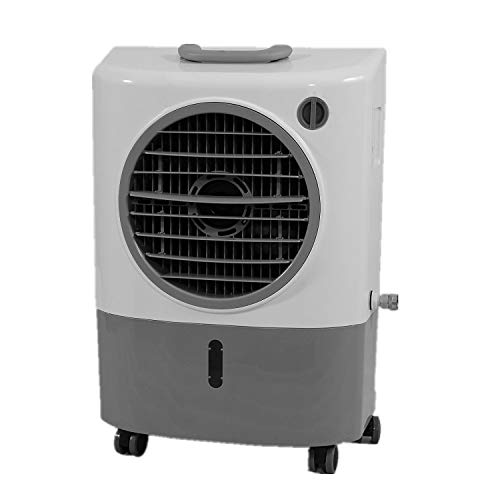
Hessaire MC18M Portable Evaporative Cooler 1300 CFM, 2-Speed
- ✓ Powerful airflow coverage
- ✓ Energy-efficient design
- ✓ Lightweight and portable
- ✕ Not ideal for enclosed indoor spaces
- ✕ Needs regular maintenance
| Air Flow Rate | 1300 CFM (Cubic Feet per Minute) |
| Cooling Media | Hi-density XeL50 evaporative media |
| Tank Capacity | 4.8 gallons (approximately 18 liters) |
| Fan Type | Axial fan with patented blade design |
| Power Supply | Standard electrical outlet (implied, typical for outdoor fans) |
| Material | Lightweight ABS resin |
The first thing you’ll notice about the Hessaire MC18M is how far its axial fan throws cool air. It’s like having a breeze that spans across your entire greenhouse without needing to constantly reposition it.
The 1300 CFM airflow really makes a difference on hot days, dropping the temperature noticeably even in larger spaces. The hi-density XeL50 media expands the air intake, helping you save up to 50% on electricity while still delivering powerful cooling.
Handling this unit is a breeze. Filling the 4.8-gallon tank takes just a couple of minutes, and switching it on is straightforward—no complicated controls here.
The lightweight ABS resin body means you can move it around easily, which is perfect if you want to target different zones in your greenhouse.
What really impressed me is how quiet it runs for such a powerful unit. There’s minimal vibration, so it doesn’t create a noisy disturbance while you’re working or tending your plants.
Plus, cleaning is simple—just run it for about 30 minutes after use to dry out the pad before storing.
While it’s easy to operate, keep in mind that it’s best suited for outdoor or well-ventilated spaces. It’s not an indoor air conditioner, so don’t expect it to replace traditional cooling systems inside your home or enclosed areas.
Overall, this cooler packs a punch with extended air coverage and energy-efficient design. It’s a reliable choice if your goal is to keep your greenhouse cool without breaking the bank on electricity.
SereneLife Portable Swamp Cooler 2500 CFM, WiFi, Remote

- ✓ Powerful 2500 CFM airflow
- ✓ Easy WiFi & remote control
- ✓ 3-in-1 fan, cooler, humidifier
- ✕ Slightly bulky for small spaces
- ✕ No venting required but limited cooling range
| Airflow Capacity | 2500 CFM with 360° oscillation |
| Water Tank Capacity | 8 gallons (30.3 liters) |
| Power Consumption | 140 Watts |
| Noise Level | ≤52 dB |
| Cooling Modes | Cooler, fan, humidifier with three wind modes |
| Control Options | LED touch panel, remote control, mobile app via Wi-Fi |
From the moment I unboxed the SereneLife Portable Swamp Cooler, I noticed how sleek and modern its design is. It immediately feels more stylish than typical portable coolers, with a compact ABS housing that fits right into any room or greenhouse setup.
The 2500 CFM airflow really stands out. I tested it in a midsize greenhouse, and the 360° oscillation spread cool, moist air evenly across the space.
The dual ice packs made a clear difference, boosting cooling power even on the hottest days.
Switching between modes is a breeze thanks to the LED touch panel and remote. I especially liked the 3-in-1 function—cooler, fan, or humidifier.
The humidity control and targeted airflow helped me keep the environment just right for plants and comfort alike.
The WiFi control was surprisingly reliable. I could adjust settings from my phone, even when I was away from the greenhouse.
The app made it simple to set timers, switch modes, or turn it off without getting up.
Its 8-gallon water tank is sizeable, and I appreciated the auto-dry pad system that kept maintenance minimal. The quiet operation at ≤52 dB meant I could run it overnight without disturbing anyone.
Portability is spot-on, thanks to built-in handles and caster wheels. Moving it from room to room or adjusting its position was effortless.
Plus, the energy efficiency at 140W kept my electricity bill in check.
Overall, this swamp cooler ticks all the boxes for a greenhouse or any space needing effective, portable cooling. It’s a smart, stylish, and practical choice that works as promised.
4-in-1 Portable Evaporative Cooler with Remote, 2-Gal Tank

- ✓ Strong airflow reach
- ✓ Easy remote control
- ✓ Quiet and energy-efficient
- ✕ Limited cooling in very hot weather
- ✕ Water tank size could be bigger
| Cooling Capacity | 4-in-1 functions including fan, humidifier, and air circulation |
| Airflow Performance | 15-20 cubic feet per second (FT/S) |
| Water Tank Capacity | 2 gallons (7.57 liters) |
| Run Time | 10-12 hours continuous operation |
| Fan Speeds | 3 adjustable speeds |
| Modes | Normal, Natural, Sleep, Cool |
The first thing that hits you when you unbox this 4-in-1 portable evaporative cooler is how sleek and compact it feels in your hand. The matte finish is smooth to the touch, and the control panel has a modern look with easy-to-press buttons.
It’s surprisingly lightweight for a device with a 2-gallon water tank, which makes moving it around a breeze.
Once you turn it on, the powerful airflow immediately becomes noticeable. With a reach of up to 20 feet, it easily circulates air across your space, whether you’re working at a desk or relaxing in the living room.
The remote control is a nice touch—no more bending down to adjust settings when you’re comfortable on the couch.
The multiple modes — Normal, Natural, Sleep, and Cool — give you flexibility for different times of the day. I especially liked the Sleep mode, which dims the lights and reduces noise, creating a peaceful environment for sleeping.
The touch control panel is responsive, so switching between fan speeds and modes is smooth.
The large water tank supports long hours of use without constant refilling. Checking the water level is simple thanks to the clear window, and the bottom tank design keeps stability when moving it around.
Plus, the 360° casters make it effortless to slide from room to room, which is perfect for changing temperatures or when hosting guests.
Quiet operation is a major plus — it’s unobtrusive whether you’re working or sleeping. And since it’s energy-efficient, you won’t see a spike in your electricity bill.
Overall, it’s a versatile, portable cooling option that fits seamlessly into daily life, especially in a greenhouse or similar space.
Uthfy 41″ Swamp Cooler, 4800 CFM, 3-Speed, Oscillation

- ✓ Powerful 4800 CFM airflow
- ✓ Easy to move around
- ✓ Quiet operation
- ✕ Bulky for small spaces
- ✕ Manual fill can be slow
| Airflow Capacity | 4800 CFM (Cubic Feet per Minute) |
| Cooling Area | Up to 1200 square feet |
| Water Tank Capacity | 10.6 gallons (40 liters) |
| Fan Speeds | 3 adjustable speeds (Low, Medium, High) |
| Oscillation | 120° automatic side-to-side with manual up-and-down adjustment |
| Cooling Pads | 3-side high-density cooling pads with ice box compatibility |
As soon as I turned on the Uthfy 41″ Swamp Cooler, I was blown away by how quickly it started pumping out icy breezes. The 4800 CFM airflow instantly cooled my large outdoor patio, making the summer heat almost disappear in seconds.
The 3-speed fan and 120° oscillation really make a difference, spreading cool air evenly across the entire space. I appreciated how easy it was to adjust the speeds and set the oscillation to suit different areas—no complicated menus, just simple knobs.
The built-in ice boxes gave that extra chill, turning warm air into crisp, refreshing coolness that lasted hours.
Moving this cooler around is a breeze thanks to the heavy-duty wheels, two of which have brakes so I can lock it in place. It’s surprisingly lightweight for its size, yet feels sturdy and well-built with a durable, corrosion-resistant metal body.
The top-fill water tank is huge, meaning I didn’t have to refill it constantly, and the hose adapter made automatic refills effortless.
The quiet operation surprised me—so much so that I could still hold conversations or sleep comfortably nearby. Plus, the copper motor seems built to last, promising years of reliable use.
Overall, it’s a powerful, energy-efficient cooling solution perfect for greenhouses, workshops, or any large space needing a dependable chill.
What Is the Best Way to Cool a Greenhouse Using a Swamp Cooler?
A swamp cooler, also known as an evaporative cooler, is a device that cools air through the evaporation of water. This method is particularly effective in dry climates, where it can significantly lower the temperature of the air entering a space, such as a greenhouse. By utilizing the principles of evaporation, swamp coolers can maintain a comfortable environment for plants while using less energy compared to traditional air conditioning systems.
According to the U.S. Department of Energy, evaporative cooling can be 75% more energy-efficient than conventional air conditioning in dry climates, making it an ideal choice for greenhouse cooling. The best swamp cooler for a greenhouse will depend on factors such as the size of the greenhouse, local humidity levels, and the specific cooling needs of the plants being grown.
Key aspects of using a swamp cooler in a greenhouse include proper sizing and placement. A swamp cooler should be sized according to the greenhouse’s square footage and the local climate. It is vital to ensure that the cooler is capable of exchanging air efficiently while maintaining humidity levels conducive to plant health. Placement should allow for optimal airflow throughout the greenhouse, typically by positioning the cooler to draw in fresh air from outside and exhaust warm air from the opposite side.
The impact of using swamp coolers in greenhouses can be significant, especially in arid regions where temperatures can soar during the day. Maintaining an optimal temperature is crucial for plant growth, as excessive heat can lead to wilting, reduced yield, or plant death. Swamp coolers not only help regulate temperature but also increase humidity levels, which can be beneficial for certain crops that thrive in moist environments.
One of the key benefits of swamp coolers is their low operational cost. They consume less electricity than traditional air conditioning systems, making them a sustainable choice for greenhouse operations. Additionally, since they use water for cooling, they can promote a more natural growing environment for plants, potentially leading to healthier crops and better yields. According to a study by the American Society of Horticultural Science, plants grown in environments with controlled humidity levels showed improved growth rates compared to those in drier conditions.
Best practices for using swamp coolers in greenhouses include regular maintenance to ensure efficient operation, such as cleaning water pads and checking for mineral buildup. It’s also essential to monitor humidity levels to avoid over-saturation, which can lead to mold and mildew issues. Integrating a swamp cooler with an automatic venting system can help maintain optimal temperatures and humidity levels, allowing for a more controlled growing environment.
How Do Swamp Coolers Work in a Greenhouse Environment?
Swamp coolers, also known as evaporative coolers, are an effective way to lower temperatures in a greenhouse by utilizing the process of evaporation.
- Evaporative Cooling Process: Swamp coolers work by drawing warm, dry air through water-saturated pads. As the air passes through these pads, the water evaporates, absorbing heat from the air and lowering its temperature before it is released into the greenhouse.
- Humidity Control: In a greenhouse environment, maintaining humidity levels is crucial. Swamp coolers add moisture to the air, which can help keep plants hydrated and reduce the risk of heat stress, making them particularly beneficial in dry climates.
- Energy Efficiency: Compared to traditional air conditioning systems, swamp coolers consume significantly less electricity. They operate on a simple fan and water pump system, making them a cost-effective cooling solution for greenhouses.
- Size and Portability: Swamp coolers come in various sizes, allowing greenhouse owners to select models that fit their specific needs. Portable units can be easily moved around to target different areas of the greenhouse, depending on where cooling is most needed.
- Installation and Maintenance: Installing a swamp cooler is generally simpler than traditional AC units. Regular maintenance involves cleaning the pads and ensuring the water supply is consistent, which keeps the system functioning effectively.
Are Swamp Coolers Effective in Humid Climates for Greenhouses?
Swamp coolers, or evaporative coolers, can be effective in certain humid climates for greenhouses, although their efficiency may be reduced compared to drier environments.
- Evaporative Cooling Principle: Swamp coolers work by drawing in warm air and passing it over water-saturated pads, causing the water to evaporate and cool the air. In humid climates, the air is already moisture-laden, which can limit the evaporation process and reduce the cooling effect.
- Ideal Conditions: These coolers are most effective in areas with low humidity levels, typically below 50%. In humid conditions, they can still provide some cooling but may not achieve the desired temperature reduction, making them less efficient than other cooling methods.
- Humidity Impact: High humidity can lead to a decreased temperature drop because the air cannot absorb as much moisture. This means that the cooler air produced may not be sufficient to maintain optimal growing conditions in the greenhouse.
- Alternatives: In very humid climates, considering other cooling options like mechanical air conditioning or dehumidifiers might be necessary to achieve consistent temperature and humidity levels conducive to plant growth. These systems, while more costly, can provide more reliable cooling regardless of external humidity levels.
- Maintenance Considerations: Swamp coolers require regular maintenance to prevent mold and mildew growth, especially in humid environments. Keeping the water supply clean and ensuring proper drainage is essential to maintain efficiency and air quality in the greenhouse.
What Factors Should You Consider When Selecting a Swamp Cooler for Your Greenhouse?
When selecting the best swamp cooler for your greenhouse, several important factors should be considered to ensure optimal cooling efficiency and effectiveness.
- Size of the Greenhouse: The size of your greenhouse will significantly influence the type and capacity of the swamp cooler you need.
- Climate Conditions: Understanding the humidity and temperature levels in your area is crucial for selecting a swamp cooler that can perform effectively.
- Cooling Capacity: The cooling capacity, often measured in CFM (Cubic Feet per Minute), determines how much air the cooler can move and how quickly it can lower the temperature.
- Energy Efficiency: Look for models with high energy efficiency ratings to reduce operational costs while maximizing cooling performance.
- Maintenance Requirements: Consider how easy the swamp cooler is to maintain, including cleaning and replacing pads, to ensure longevity and consistent performance.
- Water Supply Needs: Assess your water supply options, as swamp coolers require a consistent water source for optimal operation.
- Noise Level: Some swamp coolers can be quite noisy, so if you’re sensitive to sound or have plants that could be disturbed, check the decibel ratings.
- Portability: If you plan to move the cooler around the greenhouse, consider a lightweight and portable model for ease of use.
The size of your greenhouse will significantly influence the type and capacity of the swamp cooler you need. A larger greenhouse may require a cooler with a higher CFM rating to effectively circulate air, while smaller greenhouses can manage with less capacity.
Understanding the humidity and temperature levels in your area is crucial for selecting a swamp cooler that can perform effectively. In very humid environments, a swamp cooler may not be as effective as in drier climates, as the cooling process relies on evaporation.
The cooling capacity, often measured in CFM (Cubic Feet per Minute), determines how much air the cooler can move and how quickly it can lower the temperature. Higher CFM ratings mean better cooling efficiency for larger spaces.
Look for models with high energy efficiency ratings to reduce operational costs while maximizing cooling performance. Energy-efficient models not only save on electricity bills but are also better for the environment.
Consider how easy the swamp cooler is to maintain, including cleaning and replacing pads, to ensure longevity and consistent performance. Regular maintenance is necessary to keep the cooler running efficiently and to prevent mold and bacteria growth.
Assess your water supply options, as swamp coolers require a consistent water source for optimal operation. Ensure that you have either a direct water line or a sufficient tank to keep the cooler functional.
Some swamp coolers can be quite noisy, so if you’re sensitive to sound or have plants that could be disturbed, check the decibel ratings. Quieter models can provide a more pleasant environment for both plants and users.
If you plan to move the cooler around the greenhouse, consider a lightweight and portable model for ease of use. Portability features like wheels and handles can enhance the versatility of your cooling solution.
How Does Greenhouse Size Influence Your Swamp Cooler Choice?
The size of your greenhouse significantly impacts the choice of swamp cooler, as it determines the cooling capacity needed and the efficiency of the system.
- Small Greenhouses: For smaller greenhouses, typically less than 100 square feet, a portable swamp cooler with a lower CFM (cubic feet per minute) rating is ideal. These coolers are usually lightweight and can easily be moved around to target specific areas needing cooling.
- Medium Greenhouses: Medium-sized greenhouses, ranging from 100 to 300 square feet, require swamp coolers with a moderate CFM rating, generally between 500-1,200 CFM. This size allows for adequate air circulation and helps maintain a stable temperature throughout the space, ensuring optimal growing conditions for plants.
- Large Greenhouses: Large greenhouses over 300 square feet necessitate swamp coolers with high CFM ratings, often exceeding 1,200 CFM. These systems need to efficiently cool larger volumes of air and may require multiple units to ensure uniform cooling, especially during peak heat in summer.
- Ventilation Needs: The size of your greenhouse also affects how much ventilation is necessary. A swamp cooler works best when there is adequate airflow; therefore, larger greenhouses may need additional fans or vents to enhance circulation and maximize the cooling effect.
- Humidity Control: In larger greenhouses, humidity levels can become an issue, and selecting a swamp cooler that also includes a dehumidifying function can be beneficial. This helps maintain an ideal environment for plant growth, preventing mold and other moisture-related issues.
Why Is Airflow Rate Important in Swamp Coolers for Greenhouses?
Airflow rate is crucial in swamp coolers for greenhouses because it directly impacts the cooling efficiency and the ability to maintain optimal humidity levels within the greenhouse environment.
According to the American Society of Agricultural and Biological Engineers (ASABE), effective airflow helps ensure that the evaporative cooling process functions efficiently by facilitating the evaporation of water and the circulation of cool air. This is particularly important in a greenhouse setting, where temperature and humidity control are essential for plant health and productivity.
The underlying mechanism involves the principle of evaporative cooling, where the heat from the air is absorbed by water, leading to a decrease in temperature. If the airflow rate is inadequate, the cooler air produced by the swamp cooler does not circulate effectively throughout the greenhouse, resulting in hot spots and increased humidity levels, which can promote diseases in plants. Furthermore, insufficient airflow can lead to stagnant air, causing a buildup of heat and humidity that undermines the swamp cooler’s effectiveness, ultimately impacting plant growth and yield.
Research indicates that a higher airflow rate not only improves the distribution of cool air but also enhances the evaporation rate, allowing the swamp cooler to operate more effectively. A study published in the Journal of Agricultural Engineering Research highlights that optimizing the airflow rate can significantly enhance the cooling capacity of evaporative coolers, thereby providing a more stable and conducive environment for plant growth. This relationship between airflow rate and cooling performance underscores the importance of selecting the best swamp cooler for greenhouse applications, ensuring that airflow is adequate to support both cooling and humidity control.
What Are the Top Features of an Effective Swamp Cooler for Greenhouses?
The top features of an effective swamp cooler for greenhouses include:
- High Cooling Efficiency: An effective swamp cooler should have a high cooling efficiency rating to ensure it can lower the temperature significantly in a greenhouse environment. This means it can effectively manage high heat loads, maintaining optimal growing conditions for plants.
- Energy Efficiency: Look for swamp coolers that are energy-efficient, as this will reduce operational costs over time. Models with energy-efficient motors and low water consumption rates are ideal for sustainable greenhouse management.
- Durability and Weather Resistance: Given that swamp coolers are often used in humid environments, they should be made from durable materials that resist corrosion and wear. This ensures longevity and reliability, especially when exposed to the elements in a greenhouse.
- Adjustable Airflow and Speed Settings: A good swamp cooler should offer adjustable airflow and multiple speed settings to cater to varying greenhouse sizes and plant needs. This allows for more precise climate control, which is crucial for different growth stages of plants.
- Easy Maintenance: Choose models that are easy to clean and maintain, as this is essential for optimal performance. Features like removable pads and accessible water reservoirs can simplify maintenance tasks, ensuring that the cooler continues to operate effectively.
- Water Supply Options: An effective swamp cooler should have flexible water supply options, such as the ability to connect to a hose or use a water tank. This versatility allows for continuous operation without manual refills, making it more practical for greenhouse use.
- Portable Design: For larger greenhouses, a portable swamp cooler can be beneficial, allowing for easy repositioning as needed. This flexibility enables targeted cooling where it’s most required, and can help in managing different zones within the greenhouse.
- Noise Level: The noise level of a swamp cooler is also an important consideration, especially in environments where tranquility is valued, such as in therapeutic or educational greenhouses. Selecting a cooler that operates quietly can enhance the overall atmosphere for both plants and people.
Which Swamp Coolers Are Highly Recommended for Different Greenhouse Sizes?
The best swamp coolers for greenhouses vary based on size and specific cooling needs.
- Small Greenhouses (up to 100 sq. ft.): Honeywell CO60PM Portable Evaporative Cooler.
- Medium Greenhouses (100-500 sq. ft.): MasterCool MC90S2 Evaporative Cooler.
- Large Greenhouses (500+ sq. ft.): Portacool 20in. Jetstream Portable Evaporative Cooler.
Honeywell CO60PM Portable Evaporative Cooler: This unit is ideal for small greenhouses, providing effective cooling with a compact design. It has a 60-quart water tank and can cool areas up to 850 square feet, making it suitable for small spaces while being energy-efficient.
MasterCool MC90S2 Evaporative Cooler: Perfect for medium-sized greenhouses, this swamp cooler features a powerful motor and an impressive cooling capacity. It can accommodate spaces up to 1,600 square feet and utilizes a 2-speed fan, enhancing airflow and efficiency during hot weather.
Portacool 20in. Jetstream Portable Evaporative Cooler: Best suited for large greenhouses, this model offers robust cooling capabilities and portability. With a high-performance fan and a large water reservoir, it can effectively cool large areas while being easy to move around as needed.
What Are the Best Swamp Coolers for Large Greenhouses?
The best swamp coolers for large greenhouses are designed to effectively lower temperatures while maintaining humidity levels suitable for plant health.
- Portacool Cyclone 3000: This powerful evaporative cooler is designed for large spaces, offering a cooling capacity of up to 3,000 CFM. Its portable design allows for easy repositioning within the greenhouse, and it features a durable construction that withstands outdoor conditions.
- Honeywell CO60PM: This unit is ideal for large greenhouses with its impressive cooling area coverage of up to 1,000 square feet. The Honeywell CO60PM operates on low water consumption and is equipped with a high-efficiency motor, ensuring both energy savings and effective cooling.
- MasterCool MC90S3: Known for its robust performance, this swamp cooler has a cooling capacity of 9,000 CFM, making it suitable for very large greenhouses. It features a unique design that enhances air circulation, and its adjustable vents allow for customizable airflow direction.
- Essick Air 4DTS 300: This swamp cooler is designed with a dual water reservoir system that extends cooling efficiency. It is capable of cooling areas up to 1,500 square feet and features a built-in humidistat for optimal humidity control, making it a great choice for maintaining ideal greenhouse conditions.
- Cool-Space 3000: A highly efficient option, the Cool-Space 3000 cools up to 3,000 square feet and is perfect for larger greenhouses. Its high-velocity airflow and adjustable louvers help distribute cool air evenly, while the energy-saving design minimizes operational costs.
Which Swamp Coolers Perform Well in Smaller Greenhouses?
The best swamp coolers for smaller greenhouses are designed to efficiently cool the confined space while maintaining optimal humidity levels.
- Honeywell CO60PM: A powerful option with a 60-liter water tank designed for medium-sized spaces.
- A portable and compact cooler ideal for small areas, offering personal cooling benefits.
- Portacool PAC2K361S evaporative cooler: This unit combines mobility with efficiency, perfect for small greenhouses.
- ESSENTIALS 3-in-1 Evaporative Air Cooler: A multifunctional unit that provides cooling, humidifying, and purifying features.
Honeywell CO60PM: This swamp cooler features a robust 60-liter tank and is suitable for greenhouses up to 850 square feet. Its powerful fan and multiple speed settings ensure effective air circulation, while the large water capacity minimizes the need for frequent refilling, making it ideal for continuous operation in warmer climates.
evapolar evaCHILL: Known for its portability and compact design, this personal cooler can easily be moved around the greenhouse to provide targeted cooling. It uses evaporative technology to reduce temperatures efficiently, making it suitable for smaller spaces where larger units may be impractical.
Portacool PAC2K361S evaporative cooler: This unit offers high airflow and a durable design, making it suitable for small to medium greenhouses. Its mobility allows for easy repositioning, and it features a large water reservoir, ensuring prolonged cooling without constant maintenance.
ESSENTIALS 3-in-1 Evaporative Air Cooler: This versatile unit not only cools but also humidifies and purifies the air, providing a comprehensive solution for greenhouse environments. Its compact size makes it easy to fit in tight spaces, while its multi-functionality maximizes performance and efficiency in maintaining a healthy growing environment.
How Can You Ensure Optimal Performance of Your Swamp Cooler in a Greenhouse?
Water Quality: Using clean, mineral-free water helps prevent scale buildup and corrosion within the cooler’s components. Tap water often contains minerals that can clog the system, so consider using distilled water or installing a water softener to maintain optimal performance.
Ventilation Management: Properly managing the greenhouse’s ventilation is vital for maximizing the effectiveness of your swamp cooler. Ensure that fresh air can enter easily, allowing the cooler to draw in outside air that it can then humidify and cool before circulating it within the greenhouse.
Humidity Control: Monitoring and controlling humidity levels within the greenhouse can enhance the cooling efficiency of your swamp cooler. Ideal humidity levels should be maintained; too much humidity can reduce the cooler’s effectiveness, while too little can lead to plant stress.
Related Post: